
Nose to Nose in Nepal
- Catherine

- Jan 12
- 11 min read
Updated: Jan 13
November 7th to December 10th, 2025

We took a short flight from Hanoi to Bangkok, Thailand and spent an evening enjoying our favourite Thai foods (Thai milk tea, mango sticky rice and slow cooked sweet pork with egg). In the morning we flew to Kathmandu, Nepal.
I first visited Nepal in 2018 with my two older sisters. Nepal holds a special place in my family's heart - my parents were missionaries with United Mission Nepal for twenty two years, and my three older siblings grew up there. Although I was born in England two years after my family left Nepal, the country feels familiar.
I was excited to be back, and to share this part of my family story with Joel. The first day we spent exploring Durbar Square in Kathmandu (a royal palace from the seventeenth century) before catching a nine hour bus to Pokhara.


The plan was to complete the Annapurna Circuit and Annapurna Sanctuary treks over the next four weeks. In Pokhara we were hosted by my cousin's family, who are currently living in Nepal. After a month of meeting new people and exploring new places, it was so restful to spend time with my family.


Several days later, recharged, re-packed and re-supplied, we started our trek. From Pokhara we caught an early morning bus to Besisahar (760m). My backpack weighed about 10kg, and Joel’s weighed about 12kg.


Day 1: Besisahar to Ngadi - 12.5km, 460m ascent + 322m descent
Our bus from Pokhara dropped us off mid-day in Besisahar. We were so excited to finally start our carefully planned and much anticipated trek!
Besisahar is the original starting point for the Annapurna Circuit, but since the road was built, most people begin their treks in Jagat or Chame. For this reason, we enjoyed the first day on the trail in solitude. The trek starts at the mouth of the valley, and follows the Marsyangdi river up into the mountains. We used a paper map and an app called Maps.me to navigate.


Day 2: Ngadi to Jagat - 17kms, 1,141m ascent, 755m descent
Ngadi to Jagat was incredibly verdant. The trail threaded its way through rice paddies, wildflower meadows and small villages. This lush landscape was punctuated by several streams and waterfalls. I felt like I’d stepped back in time to catch a glimpse of rural life before cars and paved roads. Most homes had a big vegetable garden, a buffalo and some chickens. We saw several communities working together in the fields to harvest rice. It felt so simple, grounded and peaceful. As we climbed higher, we caught our first tantalizing glimpse of the snow capped peaks.
The second part of the day involved climbing hundreds of stone steps up to Jagat, a small village perched on the cliffside. At the base of this cliff is a natural hotspring, overlooking the river and a beautiful waterfall. For the small price of 200 rupees (and some more stairs) we spent several hours soaking our tired muscles in blissfully hot water, listening to the river rush and the waterfall crash, as we watched the sky darken and the stars come out.


Day 3: Jagat to Dharapani - 16.2km, 1,157m ascent, 576m descent
There are several different route options to choose from, but we used trails that avoided the road as much as possible. The Maps.me app was pretty reliable, but sometimes inaccurate as to the times or distances of the trail. Occasionally, the natural trails were in quite a state of disrepair…
The section of natural trail after Jagat involved steep rocky stairs leading abruptly up the cliffside and into thick jungle. We soon came across a goat herder camping on the trail. He was cooking his morning dhal over the fire, sheltered by an old blue tarp. A large herd of sleepy goats were strewn across the cliffside, and we had to carefully step over them to continue on the trail.
I realized that this route was not frequented by trekkers….and the reason became apparent. We suddenly emerged above the jungle and could clearly see the trail stretching ahead. It clung to the cliffside like a mangaled barnacle with large chunks missing. It was a little nerve wracking to traverse, but the views across the valley were stunning, and we passed several more waterfalls and little villages. Then the trail descended, crossed the river on a suspension bridge and began climbing the other side of the valley towards Dharapani.


Day 4: Dharapani to Chame - 18km, 750m ascent, 90m descent
Dharapani to Chame was a challenging day - my body was starting to revolt against the sudden change in physical activity level, and I felt tired and so hungry all morning. The majority of the trail on this section followed the road, which was loud and mucky. The lowpoint was being overtaken on the trail by a couple who must have been in their 70s but were somehow still moving faster than I was.
The highlights were all the sections that left the road behind, having a cup of tea with a friendly Nepali couple and eating the best momos of my life for lunch. (Maybe I was just ravenous, or maybe we discovered the best momos in Nepal!).


Day 5: Chame to Upper Pisang - 14.5kms, 600m ascent
After Chame, we were back to loving life and feeling great. This section was absolutely incredible as we entered the mountains. I loved walking through the high alpine forest, spicy with the smell of sun-warmed pine needles. Upper Pisang had an amazing view of the mountains and the valley, but it was very cold in the evenings from here on. The dining room stove would be lit for the evening meal, but otherwise the guesthouses were not heated. After dinner, we would jump into our sleeping bags and pile on the layers.


Day 6: Upper Pisang to Ngawal - 10kms, 715m ascent, 357m lost
Upper Pisang to Ngawal was another incredible day, perfect sunny weather and perfect views. The tough part was gaining 400m elevation in 1.7 km through a series of blistering switchbacks. We were fuelled by yak cheese and an encouraging rap song that Joel made up. The panoramic mountain view from the top made it all worth it. Ngawal is at 3,660 meters, sleeping at this altitude was uncomfortable but we hoped it would help our bodies acclimate.


Day 7: Ngawal to Manang - 10kms, 141m descent
This day was a very short and easy walk, descending to Manang at 3,519 meters.
Day 8 & 9: Acclimatization in Manang
The Himalayan Rescue Association Nepal recommends taking two acclimatization days in Manang before continuing the staged ascent. Although our night in Ngawal counted as an acclimatization day, we decided to play it safe and take a full two days in Manang. It was also very nice to stop for a couple days and rest! The first “rest” day, Joel did an extra 16km side quest up to Khicho Ice Lake, gaining 1,100m for a total of 4,600m elevation. I sat that one out, to give my blisters a break (my feet blistered in places I didn’t know you could get blisters).
Day 10: Manang to Yakkharka - 10.8kms, 720m ascent
After a couple days' rest in Manang, we were feeling restored and happy to get back out there. Walking up to Yakkharka was a lovely day. After seven days of hiking my body was getting strong and ascending into the mountains felt good.


Day 11: Yakkharka to Thorung Phedi - 6kms, 400m ascent
This was another short day, and we finally made it past the snowline! Thorung Phedi is at 4,540m. As soon as the sun dipped behind the mountains at 3pm it immediately became frigid. We went to bed early, planning to start the ascent over the Thorung La pass at 4am the next day. At 5,416m, it’s one of the highest navigable passes in the world. Once over the pass, we had planned to finish the circuit at Ghorapani and then hike across to join the out-and-back Annapurna Sanctuary (base camp) trail. Unfortunately, I got a severe headache around midnight. If you get mild symptoms of altitude sickness (which is common), you can remain at your current altitude until the symptoms go away and then you can continue ascending. If you get any severe symptoms, you have to descend. Altitude sickness can be fatal, and the only real treatment is descent. From Thorung Phedi we still needed to ascend around 900 meters to reach the top of the pass.


Day 12: Backtrack 16.8kms & descend to Manang
At 3am our alarms went off. My headache was still bad, so we decided to stay put for the day and see if my body would acclimatize. By late morning the headache remained acute, and so we decided to descend 490m to Yakkharka for the night. This was not an easy decision to make, as we were so close - only about 4-5hrs walk from the highest point of the trek and then we would start to descend over the other side of the pass.
As it was, I would have been able to continue trekking with the headache. But if it had gotten any worse, or if I started to have any of the other acute symptoms (discoordination, confusion etc), I may not have been able to continue walking. The pass got a huge snow dump in October, so it was icy and single file the whole way and so would be an extra difficult area to be evacuated from). We had budgeted plenty of extra days in our trekking plan just in case, so we decided to play it safe and descend. We hoped to then try again from Thorung Phedi the next day.
We reached Yakkharka in the early afternoon. The headache and general unwell feeling was still going strong by early evening. The general advice is that if you get severe symptoms of altitude sickness, you should descend at least 400m, but 1,000m is recommended. After descending, the symptoms should improve between six hours to three days.
I was still feeling miserable at this point, and Joel made the call to continue to descend to Manang. I really didn’t want to go all the way back to Manang, but Joel reminded me that we’d promised both our mothers that we would be safe - it was hard to argue with that! It was so frustrating that despite doing all the careful acclimatization things, I still got altitude sickness!
But we had good headlamps and there was a beautiful moment where the stars came out and we could clearly see the milky way behind the black silhouette of the himals.
Day 13 to 17: Manang…again
I saw an American doctor in Manang the next day (a volunteer at the Himalayan Rescue Association). He upped my dosage of Diamox (a medication that helps altitude sickness) and said we could make a second attempt in a couple days - if I started feeling better. If I got another severe headache, I'd need to come down again right away.
We’d met a friendly German guy on the way up to Thorung Phedi, and Joel bumped into him again in Manang - he also descended the same day due to a severe headache. It was comforting to know that I wasn’t alone in my experience!
Day 18-20
I recovered from the altitude sickness after two days in Manang, but then Joel got really sick with a fever/headache/runny nose and had to spend the next three days in bed. On the day that Joel was doing slightly better, I woke up feeling terrible with a bad cough. At this point, we’d used up all of our extra days and had run out of wiggle room.
As all you dear friends and family well know, me and Joel are evenly matched in terms of stubbornness. We made the joint decision to try the ascent again, hoping that we would both start to feel better soon.
I became out of breath easily - even on flat sections. It was hard to get enough air, and what had felt so easy and quick the first time took twice as long and about a thousand times more effort.
Neither of us slept well that night. In the morning, we couldn’t imagine making it over the pass on the next day, so we stayed put. The next day, my cough had worsened and I’d had enough. At altitude it was hard to stay warm, difficult to sleep, difficult to breathe, and I’d lost my appetite. I finally realized that at this rate, my health wasn’t going to improve any time soon and that we needed to go back to Pokhara to recover. There’s only so far that pure will power can get you, and then it leaves you high and dry!
It was so sad for both of us to give up on completing the trek. We’d been carefully planning and looking forward to it for over a year, and it was finished already.
Walking back to Manang (again) was a real low point. Even though we were walking downhill most of the time, it was very slow going as I felt dizzy and had to take frequent breaks.
Day: ? It's a blur
The next morning we took a jeep from Manang to Besisahar, a very bumpy seven hour ride. We spent the night in Besisahar and then caught the first bus back to Pokhara in the morning. The continual transit was not helping matters and my fever, cough and sore throat got worse. At this point, I suspected an lower respiratory tract infection of some kind, and knew I needed to see a doctor and get started on antibiotics.
Once arriving in Pokhara, we went directly to a medical clinic. I was quickly seen by an excellent Nepali doctor. In talking through the different symptoms, the doctor mentioned they were consistent with a lower respiratory infection such as pneumonia or tonsillitis. Part way through the consultation I asked, “which one is it, pneumonia or tonsillitis?”, he looked at me with surprise and said “oh, you’ve definitely got both!”
Yikes! That explains why trekking became so difficult.
The doctor promptly started me on antibiotics, along with a veritable pharmacy of other drugs.
The next few days are hazy. Upon reaching two weeks of cold-like symptoms, Joel also decided to see the doctor - it turned out he had an upper respiratory (sinus) infection. It was respiratory infection bingo! We were both in bed with antibiotics for about a week after that.
We finally emerged from the worst of it and started to feel more human. Then we contracted violent food poisoning simultaneously. I won’t go into the gory details, but it was not good, and we had to share one bathroom. Enough said.
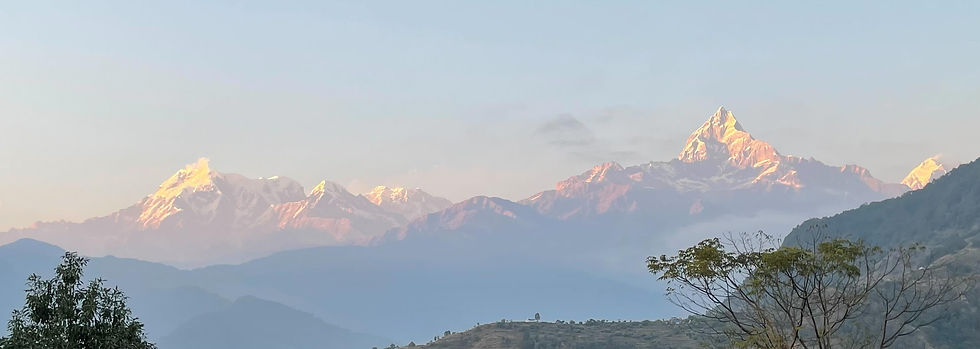
It was in this grey tinged state that we tottered back to my cousin's house for our last day in Pokhara. We still managed to have a lovely time together and visited the boarding school where my Dad had taught gym (fresh out of graduating from the University of Calgary). Then we watched a pink sunset over the Annapurnas around a toasty campfire.


At the start of the trek, I was having fun thinking about how I’d write about it. I thought the trek was a great analogy for life. We are all journeying towards the same destination, it’s a challenge for everyone and you can’t compare your journey to others. Some people get a head start. Some hire porters to carry their bags, while others pack their bags too heavy and struggle under the weight. Some people follow a map, others have a guide, most get a little lost. Some are affected by past injuries. Some have good quality, comfortable shoes while others wear flip flops. But all are walking the same road, on the same two feet.
Nice right? But when things went sideways, my tidy analogy started to become uncomfortably truthful. Sometimes, the journey doesn’t go according to plan. Things happen that are beyond your control, that you thought might happen to other people, but never to you. You end up in unexpected places at unexpected times and by unexpected means. You discover your own immutable limitations. It’s painful, it’s frustrating and it’s humbling.
I’m on a continuous journey of being humbled, and repeatedly butting heads with my limitations. Maybe one day, I’ll be able to spot my limits from far away instead of nose to nose.


Comments